



Inside dfcu Bank’s Strategic Play in Asset Financing
Vehicle and Asset Financing (VAF) is a structured solution that enables individuals and businesses to acquire essential assets, including vehicles, machinery, and equipment, without the burden of full upfront payment. By aligning repayments with cash flows, it allows customers to invest in productivity today and pay overtime, using the asset itself to generate value.
For Gloria Ssuuna Namutebi, Head of Vehicle and Asset Finance at dfcu Bank, this goes beyond financing, it is a direct enabler of economic activity.
“At its core, Vehicle and Asset Financing is about unlocking productivity,” she explains. “Across sectors such as transport, construction, agriculture, and light manufacturing, access to the right asset determines how efficiently a business can operate, how quickly it can scale, and how competitive it becomes.”
In her view, the real constraint facing many Ugandan businesses is not ambition, but access to the tools required to execute. By removing the burden of upfront capital, dfcu enables businesses to move faster, expand capacity, and participate more meaningfully in the economy.
This thinking informs how dfcu structures its VAF offering. Rather than a standardised product, the Bank provides a suite of solutions, including finance leases, asset loans, and insurance premium financing, each tailored to customer cash flows and operating realities.
“It is about structuring solutions around the customer, not forcing customers into fixed products,” Gloria notes. “For individuals, that means accessibility and manageable repayment terms. For businesses, it means aligning financing to project cycles and operational cash flows.”
The breadth of assets financed reflects the diversity of Uganda’s economic landscape. dfcu supports the acquisition of personal and commercial vehicles, construction and industrial equipment, and agricultural machinery such as tractors and irrigation systems. It also finances specialised equipment, including medical devices, generators, and solar solutions. Assets of up to 15 years can be financed, subject to quality and marketability assessments.
Within this scope, Gloria highlights the broader economic role of VAF. “When a logistics company expands its fleet, when a contractor acquires new equipment, or when a farmer transitions to mechanised agriculture, the impact is immediate, increased productivity, greater efficiency, and often job creation.”
In an increasingly competitive market, she identifies three areas where dfcu is intentionally differentiated: depth of financing, speed, and ecosystem support.
“With up to 100 percent financing in select segments, we are significantly lowering the entry barrier. At the same time, our turnaround times are designed to support business momentum, typically within three to five days,” she says. “Beyond that, we are building an ecosystem around the customer, connecting them to credible suppliers, ensuring asset quality, and supporting the full acquisition journey.”
That ecosystem is reinforced through partnerships. dfcu works with Mantrac to support access to construction and heavy equipment, enabling infrastructure players to acquire high-value machinery without tying up capital. In the mobility space, its collaboration with World Navi integrates pre-inspected vehicles, warranties, and insurance into a seamless financing process.
“Our partnership with World Navi partnership is about removing uncertainty for individuals who are looking personal use cars,” Gloria explains.
“Customers are able to access quality vehicles with full visibility on condition, backed by warranties and structured financing.”
For brand-new vehicles, dfcu collaborates with CFAO, the Toyota brand dealer, while in the commercial segment it partners with Mac East Africa, dealers for the Isuzu brand.
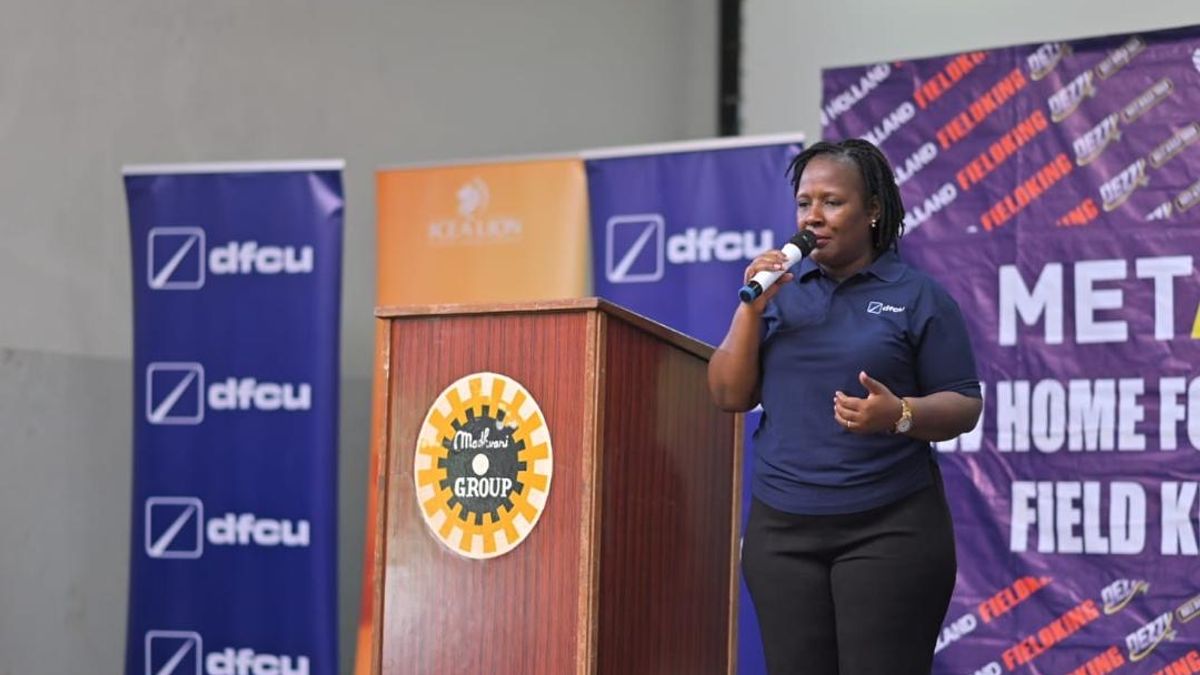
In agriculture, dfcu’s partnership with Meta Plant and Equipment Uganda Limited is advancing mechanisation, an area Gloria identifies as both a challenge and a significant opportunity.
“Agriculture is central to Uganda’s economy, but productivity remains constrained by limited mechanisation. Through our partnership with Meta, we are enabling farmers to access modern equipment with up to 90 percent financing, significantly reducing the upfront burden,” she says.
This is complemented by on-ground activations in regions such as Jinja and Soroti, where equipment demonstrations are combined with on-site financing approvals, bringing solutions closer to customers and accelerating adoption.
Ultimately, Gloria emphasises that success in Vehicle and Asset Financing is not defined by portfolio size alone.
“For us, success is about impact,” she says. “Each asset we finance should enable income generation, support job creation, and unlock business growth. Our role is to make it easier for customers to move from ambition to execution.”
In this role, dfcu is positioning Vehicle and Asset Financing not merely as a product, but as a catalyst for enterprise growth and a driver of Uganda’s productive capacity.